

New Heracell CO2 Incubators deliver features that support emerging automated cell therapy production processes
To support the future implementation of workflow automation in cell therapy production, Thermo Fisher Scientific introduces the Thermo Scientific™ Heracell™ VIOS™ 250i AxD CO2 Incubators. These first-of-their-kind CO2 incubators are designed for integration into automated and modular laboratories. The VIOS family of incubators are known for optimal cell growth conditions and minimal contamination risk. Now adding the innovation of patent-pending automated door control, the Heracell VIOS AxD CO2 incubator opens automatically when integrated into a centralized lab automation platform, allowing vessel loading and unloading through robotic control and supporting continuous cell therapy production processes.
Emerging cell therapy manufacturers, biotech, and pharmaceutical companies focused on bringing advanced therapies to market want to automate production of cultured cells without compromising quality. The new innovative design of the Heracell VIOS Incubator modernizes cell therapy production without compromising on contamination control features.
To support the future implementation of workflow automation in cell therapy production, Thermo Fisher Scientific introduces the Thermo Scientific™ Heracell™ VIOS™ 250i AxD CO2 Incubators. These first-of-their-kind CO2 incubators are designed for integration into automated and modular laboratories. The VIOS family of incubators are known for optimal cell growth conditions and minimal contamination risk. Now adding the innovation of patent-pending automated door control, the Heracell VIOS AxD CO2 incubator opens automatically when integrated into a centralized lab automation platform, allowing vessel loading and unloading through robotic control and supporting continuous cell therapy production processes.
Emerging cell therapy manufacturers, biotech, and pharmaceutical companies focused on bringing advanced therapies to market want to automate production of cultured cells without compromising quality. The new innovative design of the Heracell VIOS Incubator modernizes cell therapy production without compromising on contamination control features.


“Human handling and complex processes limit broad availability of cutting-edge cell therapies to treat cancer, autoimmunity, and orphan diseases. Automation could play a vital role in producing therapies in a more economical and safer fashion,” said Douglas Wernerspach, Senior Business Director, general manager - CO2 Growth, Protection and Separation products, Laboratory Products at Thermo Fisher. “Very few automation solutions available on the market allow for multiple large sample vessels in various laboratory workflows. This novel CO2 Incubator brings our customers closer to a fully automated lab.”
The Heracell VIOS 250i AxD CO2 Incubators are the most advanced incubators in the VIOS portfolio. Thanks to its excellent cell culturing conditions that help ensure critical quality attributes of cells, Heracell VIOS 250i AxD CO2 incubators support the emerging automated cell therapy production processes on a large scale, culminating in an advancement that helps improve human health by supporting the cell manufacturing process within cell and gene therapies.
Features include:
- In-chamber HEPA filtration capturing all particles regardless of size, protecting cultures from airborne contaminants that can enter any incubator when the door is opened.
- Thermo Scientific™ THRIVE™ active airflow for homogeneous culturing conditions throughout the incubator chamber. The Thermo Scientific Steri-Run™ Cycle, which is independently proven to reach a 12-log sterility assurance level, eliminating more than one million biological indicators for both dry heat sterilization and autoclave sterilization in half the lethal time used in production models.
Incubator shakers are commonly used for cultivating cells and microorganisms, as many chemical and biological processes rely heavily on their control of temperature and shaking speed. For instance, temperature fluctuations can induce structural changes in proteins, leading to a rapid loss of function and erroneous results. However, achieving and maintaining precise control of temperature and shaking speeds has proven challenging for many labs.
Space limitations can further complicate operations. The typical physical footprint of incubator shakers, combined with their need for sufficient clearance for ventilation and maintenance access, can make placement challenging. This can restrict throughput and hinder the scalability of operations.
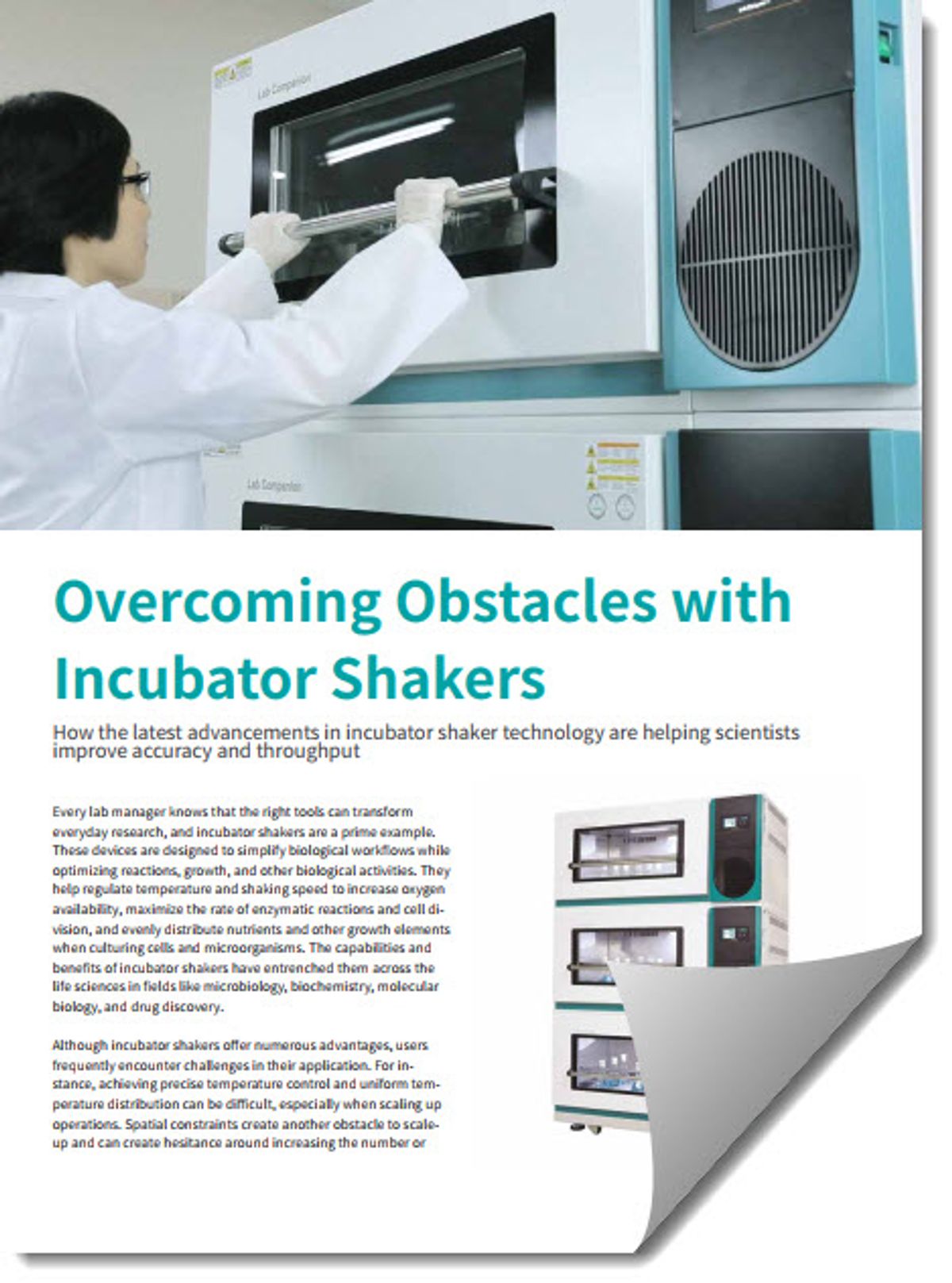
Fortunately, the latest advancements in incubator shaker technology address these pain points, offering innovative features that help labs maintain experimental integrity and boost efficiency. By equipping themselves with a thorough understanding of these features, lab managers can make informed decisions that ultimately improve research outcomes.
This comprehensive white paper explores these technological advancements and provides lab managers with practical strategies to overcome common challenges. It also includes a detailed, step-by-step guide for optimizing protein expression workflows using an incubator shaker.
Download this whitepaper to learn:
- Best practices for maintaining precise control over temperature and shaking speed
- Strategies to maximize lab space and throughput
- Benefits of real-time monitoring and advanced safety features in incubator shakers
- Key features to look for when purchasing an incubator shaker
- Practical steps for optimizing protein expression workflows
Think of your lab as a finely tuned orchestra where lab managers play the role of conductors, coordinating lab equipment, logistics, chemicals, and consumables to ensure the lab operates in perfect harmony. This coordination is crucial for day-to-day operations and research endeavors' long-term success. However, without regular assessments to fine-tune these components, the lab’s performance may suffer, leading to delays in research activities, inflated budgets, and the depletion of valuable resources.
Addressing these inefficiencies can seem daunting, often requiring a substantial amount of time, effort, and expertise—resources that many labs, especially those with limited staff, find challenging to allocate. This is where a lab assessment, backed by a comprehensive lab services provider, can be invaluable. Such assessments evaluate “science-readiness” by examining how a lab manages its equipment, logistics, chemicals, and consumables. This offers critical insights into a lab’s operational state, highlighting areas where improvements can be made to enhance efficiency and safety. Partnering with a comprehensive lab services provider for these assessments also grants labs access to specialized expertise and innovative solutions that go beyond their internal capabilities, allowing scientists to focus on their primary objectives and driving scientific discovery forward.
Equipment: Ensuring operational efficiency
Proper equipment management is essential for maintaining operational efficiency, encompassing preventive maintenance, calibration, and timely upgrades. Neglecting these best practices can lead to frequent breakdowns, increased repair costs, and derailed research projects. A lab assessment that evaluates science-readiness plays an important role in equipment management, as it evaluates the current condition of lab equipment and recommends necessary improvements to prevent critical failures.
A common recommendation from lab assessments is for labs to develop a comprehensive equipment database. This database should catalog every service performed on each piece of equipment, along with the associated costs and maintenance frequency. Such a resource enables lab managers to select suitable service agreements and anticipate when equipment is nearing the end of its life cycle. With this knowledge, labs can proactively budget for replacements, drastically reducing the likelihood of unexpected equipment failures.
In the face of organizational changes, the need for a robust equipment management system becomes critical, a lesson highlighted by one lab’s transition to a brand-new, state-of-the-art facility. Initially, the lab didn’t assess its equipment management protocols, which led to several issues, including bioreactor pressure inconsistencies that threatened to delay crucial research and development efforts. Recognizing the importance of preventive maintenance, the lab established a strategic partnership with a dedicated and responsive lab services provider. By applying an innovative approach to problem-solving, the provider resolved the company’s equipment issues and enhanced its equipment management strategy.

Logistics: Streamlining lab operations
Logistics is the often-unseen yet critical backbone of lab operations. It plays an essential role in ensuring experiment preparedness, adherence to safety protocols, and the coordination of staff and resources. Evaluating these elements becomes especially crucial during significant changes and growth, such as scaling operations, integrating new teams and technologies, or shifting research focuses, which typically strains existing operations.
A pharmaceutical company facing support and staffing shortages while relocating to a larger facility experienced this operational strain firsthand. To address these challenges, the company enlisted a logistics-focused lab services provider known for its custom relocation assistance. The provider began by conducting a comprehensive lab assessment, which played a pivotal role in enhancing strategic on-site support and optimizing service delivery. This assessment also ensured the new facility was primed for peak productivity and innovation. After the relocation, the provider continued its collaboration with the company’s lab operations teams to ensure the labs remained science-ready.
Chemicals: Safeguarding health and compliance
The journey of a chemical through a lab, from receipt to disposal, requires thorough oversight to ensure the safety of lab personnel. Establishing a chemical safety program within your lab can help mitigate these health and safety risks and lower the environmental impact and operational costs associated with chemical management.
Creating such a program is a multi-faceted process that requires careful assessment (and re-assessment) of several key components, including handling, labeling, storage, and disposal protocols. This ensures the segregation of incompatible chemicals, mitigating the risk of unintentional reactions. A thorough assessment will also evaluate the availability of safety data sheets and a lab’s chemical management strategy across every stage of a chemical’s lifecycle. These practices equip lab personnel with the necessary information for managing chemicals safely.
Despite the potential consequences of insufficient chemical management, labs frequently face challenges when evaluating their practices. This often stems from a lack of well-defined processes and understanding of regulatory compliance standards. This is where collaborating with an external lab services provider that specializes in lab assessments becomes invaluable. These partnerships can greatly simplify the chemical management process by identifying potential gaps in safety measures, recommending improvements, and assisting in the adoption of best practices. Such support ultimately facilitates compliance and boosts the efficiency and safety of lab operations.

Consumables: Optimizing resource use
Effective consumable management is fundamental for ensuring uninterrupted research activities. However, the process of ordering and managing consumables is unstructured and uncoordinated in many labs. In some labs, individuals place orders independently when they notice supplies running low, instead of having a designated person or team who follows a well-defined purchasing process. Unfortunately, this can lead to stock hoarding, expired stock, and wasted lab space, which drives up costs and contributes to operational inefficiencies. This lack of organization can also complicate the maintenance of accurate inventory records, creating additional obstacles in financial management and resource allocation.
Addressing inventory management challenges early on through a comprehensive lab assessment was crucial for one bioscience company. Swamped with deliveries, the company’s scientists, tasked with unpacking and organizing the contents, were inadvertently discarding packing slips and neglecting to update stockroom records. This oversight created hurdles for the finance department when it came time to process payments. The company then turned to an external lab services provider to address these compounding challenges and regain control over its consumables spending and usage. After evaluating the company's consumable management practices, the provider introduced a robust receiving and vendor-managed inventory (VMI) program. This intervention restored order to the stockroom, reduced waste, liberated funds for research and development, and relieved scientists from the burdens of inventory management.
The Flagship formula: A comprehensive solution for lab support
Partnering with Flagship Lab Services allows lab personnel to concentrate on their research with renewed confidence, thanks to the central role of their Science-Ready Assessment (SRA). This evaluative tool, designed to gauge a lab’s operational efficiency, produces a detailed readiness score comprising a lab’s strengths and weaknesses in equipment, logistics, chemicals, and consumables management. Specifically, it verifies that equipment is properly maintained and calibrated, essential reagents and materials are readily accessible, power supplies are reliable, ventilation and waste management systems are sufficient, and staff are well-trained. The assessment also ensures lab personnel operate safely, supported by appropriate processes, procedures, training, equipment, and materials management practices. Leveraging these comprehensive insights, Flagship crafts a customized support plan carefully aligned with a lab’s unique needs and objectives, ensuring they are truly science-ready.
Flagship additionally offers a suite of lab services that complement the findings and recommendations found in the SRA. These services include lab support, VMI programs, lab equipment calibration, validation, and repair, janitorial work, and mechanical, electrical, and plumbing work. Moreover, Flagship's adept project management ensures smooth transitions during moves and expansions, while its testing and certification services help labs uphold compliance and quality standards.
By positioning the SRA at the core of its service offerings, Flagship can easily identify the best way to support a lab’s immediate and future needs. This holistic approach has positioned Flagship as the first nationwide provider of integrated lab and facility maintenance services, keeping labs safe, compliant, and thoroughly prepared to meet the demands of advanced scientific research.
For more information about Flagship Lab Services, visit www.flagshipinc.com/lab-support-services